

As an Amazon Associate I earn from qualifying purchases. DetailRivet is a participant in the Amazon Services LLC Associates Program, an affiliate advertising program designed to provide a means for sites to earn advertising fees by advertising and linking to Amazon.com.
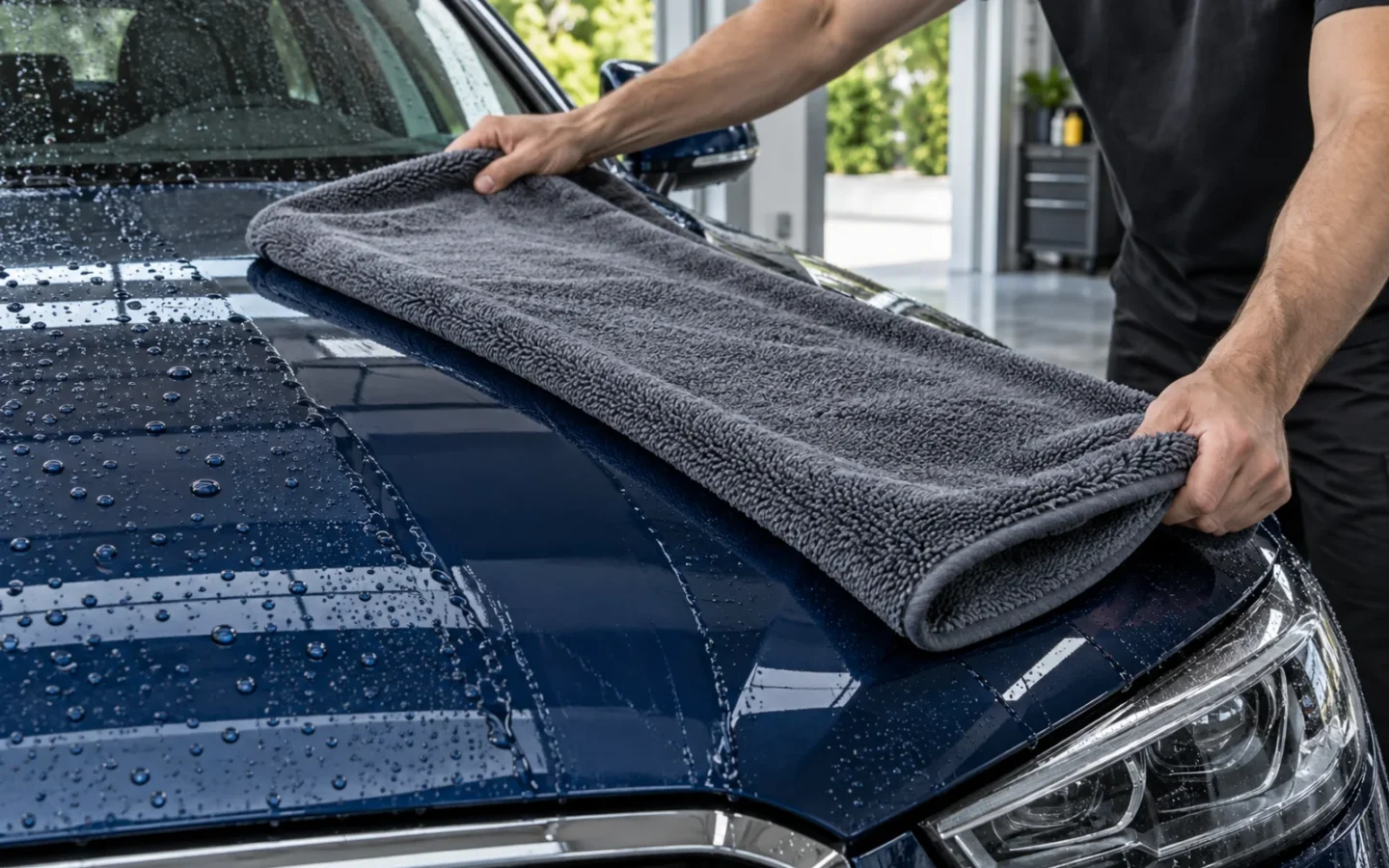
A large microfiber drying towel can remove a remarkable amount of water, yet the biggest towel is not automatically the safest. Once saturated, it becomes heavy, harder to control, and more likely to touch wheels or the ground.
Drying starts with the final rinse. If visible soil remains, a towel turns that missed contamination into contact across the panel. Fix the wash before asking a softer towel to hide it.
This guide covers clean glossy exterior surfaces after a contact wash. Follow coating instructions for drying aids, and use separate towels for paint, glass, jambs, wheels, and exhaust areas.
Choose control before maximum size
A towel must be large enough to absorb efficiently but small enough that every edge stays in your hands and off dirty lower surfaces. The distinction matters because the visible symptom is often one step removed from the cause. Start with the mechanism and the rest of the decision becomes easier to audit.
Compare dimensions to your reach, fold the towel into manageable faces, and plan a second towel for the remaining water. Change one variable at a time and keep the first pass conservative. That gives you a comparison point and makes it easier to reverse course before damage or frustration compounds.
If a wet towel sags against tires or the floor, it is too large for that technique regardless of its capacity. If that signal moves in the wrong direction, stop and return to the last known-good state. More product, pressure, height, heat, or time is rarely the best first correction.
Match pile and construction to the task
Twisted-loop and plush weaves manage water differently, while borders, tags, and worn fibers create their own contact points. Treat this as a system rather than a shopping problem. Size, placement, material, routine, and the person or animal using it can all change what “good” looks like.
Inspect both faces and edges, remove detachable tags carefully, and reserve waffle or low-pile towels for glass when that is where they perform best. Prepare the entire path before starting: the work area, the tools, the cleanup, and the place where the item goes next. Interruptions are when shortcuts usually enter the process.
Any stiff seam, hardened patch, exposed backing, or embedded particle disqualifies the towel from paint. Judge the result after the system has settled, not only in the first few seconds. Early improvement can hide wobble, residue, fatigue, crowding, or a maintenance burden.
Use a clean final rinse to reduce work
Water sheeting from a protected surface can leave less standing water and reduce the number of towel passes. A useful recommendation has a boundary. It should explain not only why an approach works, but also the conditions that make another approach more sensible.
Rinse from top to bottom, use an open stream where appropriate, then address mirrors, badges, grilles, and seams that continue dripping. Use the least aggressive method that can answer the question. Escalation should follow evidence from a small test, not impatience with the first minute of work.
If runoff carries dirt, return to washing that area rather than drying through it. Use the check as a decision gate: continue only when the basic condition is stable. Otherwise, change the setup before buying an accessory meant to compensate for it.
Blot or glide with light pressure
Absorbency comes from fiber structure and capillary action, not from pushing the towel into the clear coat. This is where small constraints deserve more attention than headline specifications. The limiting detail is often access, clearance, stability, cleanup, or repeatability.
Lay the towel flat on horizontal panels or make slow controlled passes while holding its edges away from dirty gaps. Write down the measurement or take a reference photo when memory would otherwise decide. A repeatable check is more useful than a confident impression.
Chatter, drag, or a dry streak indicates saturation, residue, or a surface that needs more rinse water. Do not average away an outlier that affects safety or comfort. One blocked exit, sharp edge, unstable joint, hot spot, or persistent mark can outweigh several convenient features.
Change faces before contamination spreads
A towel can pick up missed grime around emblems, lower doors, jambs, and trim without showing it from arm’s length. The goal is not maximum intensity. It is a result that can be repeated without creating a second problem somewhere else in the routine.
Fold into clean sections, inspect frequently, and switch to a utility towel before touching lower-risk areas. Build the routine around the difficult moment, not the ideal one. If a step is awkward when the room is busy or the item is wet, redesign that step now.
A discolored or gritty face never returns to open paint during the same session. The best result is usually boring: predictable, easy to maintain, and clear about when it needs attention again. Novelty is not a substitute for control.
Wash for absorbency, then store closed
Fabric softener, wax residue, lint, and high heat can turn a premium towel into an expensive water pusher. Good setup removes guesswork before it adds equipment. A clear baseline makes later changes legible instead of turning every adjustment into a new experiment.
Wash drying towels with compatible microfiber loads, use residue-free detergent, dry on low, and place them in a clean lidded bin. Leave enough time to inspect the result under ordinary conditions. A setup that only looks right during installation has not yet passed a useful test.
Test absorption with clean water before the next use; persistent beading on the fibers means the wash routine needs correction. When the evidence stays ambiguous, pause. A different tool, a professional assessment, or simply more observation may be cheaper than forcing a conclusion.
Record the baseline before changing more
Keep a short note of the starting condition, the exact setup, the order of work, and the first result you could verify. Include measurements, product dilution or settings when relevant, and a photograph taken from the same position and light. The note does not need to become a project log; it only needs enough detail to separate a real improvement from a change in memory, angle, weather, or expectation.
Set the next inspection by use and condition rather than an arbitrary urge to intervene. A stable setup may need only cleaning and a quick check, while a new noise, mark, wobble, odor, leak, behavior change, or loss of performance deserves an earlier look. Maintenance is most useful when it catches a small drift before the remedy becomes more aggressive than the original job.
Use the result to narrow the buying decision
Translate the successful setup into requirements before comparing listings. Write down the usable dimensions, material limits, access needed for cleaning, compatible consumables, and the one or two features that solved the original problem. Separate those requirements from conveniences and decorative details. This prevents a long feature list from displacing the physical constraint that made the equipment useful in the first place, and it gives you a direct reason to reject a product that cannot fit the routine.
Consider ownership after the first week as seriously as the unboxing. Check whether wear parts are available, whether the item can be disassembled without damage, where it will dry or be stored, and how failure becomes visible. Read the current manual and dimensions for the exact model because names and bundles can remain similar while specifications change. A slightly simpler product that can be inspected, cleaned, and used consistently is often the more durable recommendation.
When two options meet the basic requirements, compare the downside you would actually have to manage: extra floor area, a slower cleanup, recurring filters, a louder motor, more supervision, or a surface that wears sooner. Do not invent precision by ranking features that have no effect on this use case. The recommendation should remain conditional and easy to revisit when the space, user, animal, material, or routine changes.
Before committing to a purchase, verify the current model number, included parts, dimensions, warranty, return terms, and the latest manufacturer instructions. Marketplace titles and bundles change, so a familiar product name is not proof that a listing contains the same version described here. Keep the recommendation tied to the requirement it solves, and reject substitutions that remove a safety, fit, cleaning, or compatibility feature your setup depends on.
Recheck the setup after several ordinary uses. Look for the friction that appears only during cleanup, storage, refilling, charging, adjustment, or handoff to another person. If the routine consistently invites a shortcut, change the arrangement before adding more equipment. Long-term value comes from a tool remaining understandable and maintainable when the initial enthusiasm is gone.
A practical check before you finish
- Final rinse leaves no visible soil.
- Towel size remains controllable when wet.
- Edges and fibers pass close inspection.
- Paint towels never touch wheels or the ground.
- Clean faces are exposed throughout drying.
- Washed towels absorb water before returning to service.
A product that fits this approach
A twisted-loop drying towel is useful when its chosen size remains controllable and the towel is kept within a paint-only laundry and storage system.
The Rag Company The Liquid8r Drying Towel
Why we picked it
- Twisted-loop construction is designed for high water pickup
- Multiple sizes let the user trade capacity for control
- Soft border is less intrusive than a hard woven edge
Reported drawbacks
- Large sizes become heavy when saturated
- Needs careful washing to preserve absorbency
- Cannot make residual grit safe to wipe
The useful stopping point
The safe drying system is a clean rinse, a controllable towel, light pressure, frequent inspection, and strict task separation. Capacity is useful only while the towel remains clean and under control.