

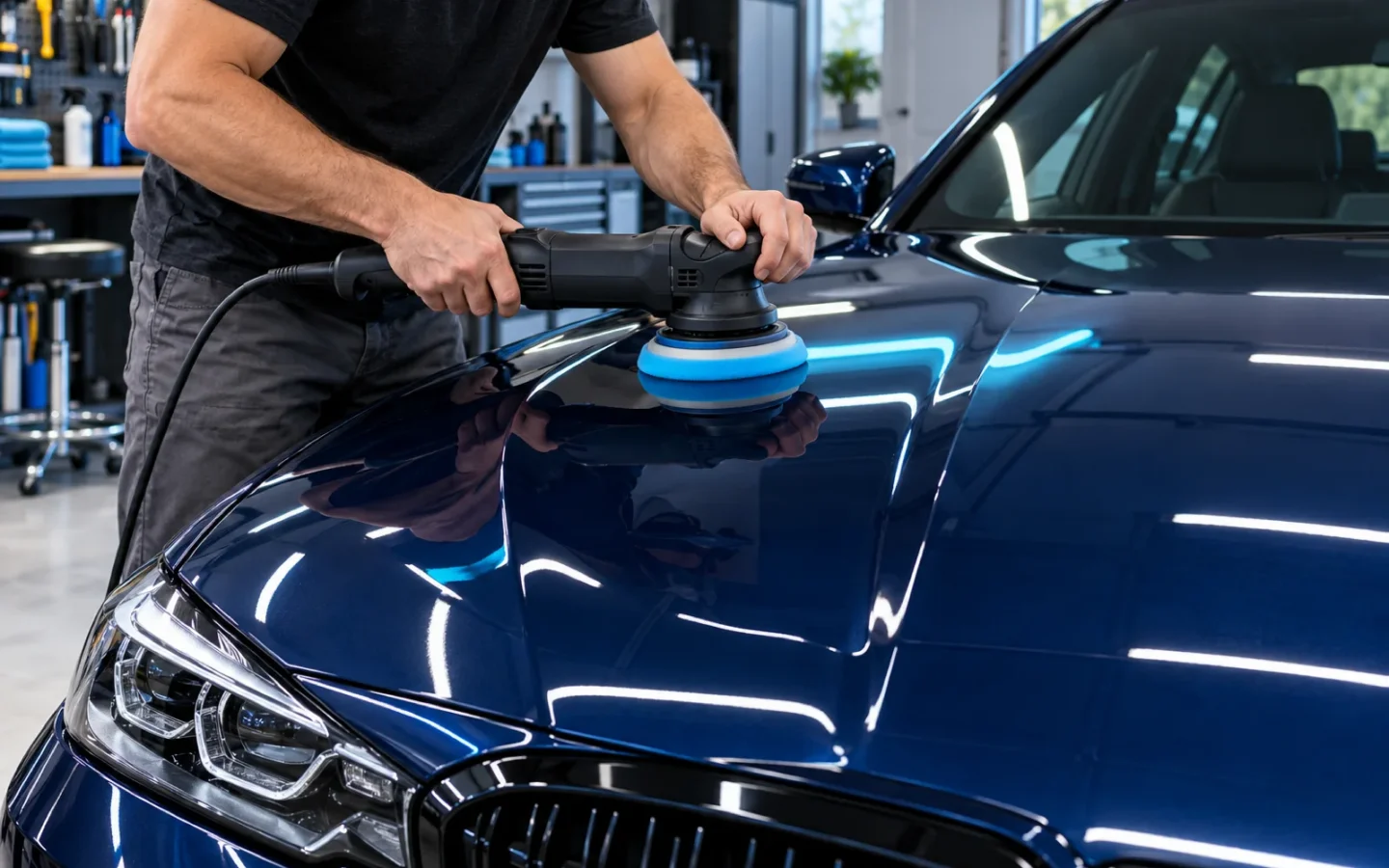
Paint correction removes a measurable amount of clear coat to level the surface around scratches. The goal is not to chase every defect. It is to improve clarity while preserving enough material for the rest of the vehicle’s life.
Why dual action is the sensible starting point
A dual-action machine rotates and oscillates the pad. When the pad meets too much resistance, rotation slows or stalls instead of concentrating all motion in one place. That behavior lowers risk compared with a direct-drive rotary, but it does not make heat, edge pressure, or thin paint irrelevant.
Inspect before choosing a compound
Wash, chemically decontaminate, and clay only when bonded contamination remains. Under a strong inspection light, separate wash marring from isolated deep scratches, etched water spots, sanding marks, and failing clear coat. Those are different problems and do not deserve one aggressive answer.
If you have access to a paint-thickness gauge, use it as context rather than permission. It measures total film on many panels, not a precise clear-coat reserve. Repainted areas and edges can behave differently even when the number looks comfortable.
Begin with a test spot
Choose a representative section about shoulder-width square. Start with a polishing pad and a finishing or medium polish, make a controlled set of passes, wipe the residue with clean microfiber, then inspect from multiple angles. Increase aggression only when the test spot proves that the mild combination cannot reach the reasonable target.
Technique controls the result
Keep the pad flat, use slow overlapping passes, and avoid loading the machine until the backing plate tilts. Clean the pad frequently; spent abrasive and removed paint turn a soft pad into an inconsistent cutting surface. Large sections feel faster and usually produce less correction because the polish is spread too thin and the pad spends too little time on each area.
Know when to stop
A scratch that catches a fingernail, a sharp body line, an unknown repaint, or a panel with clear-coat failure is not a challenge to solve with another pass. Improvement without full removal is often the technically correct finish.
After polishing, remove residue according to the polish manufacturer’s instructions and apply protection. The gloss comes from the leveled paint; the sealant or coating preserves that work and makes maintenance easier.